
- Practical Engineering Perspective
- Material Characteristics Specific to Fly Ash and Coal Slurry
- Regulatory Context Driving CCR Pond Dewatering Projects
- Closure-in-Place vs. Closure-by-Removal Implications for Separation
- Beneficial Reuse Considerations
- Coordination With Groundwater Monitoring and Environmental Compliance
- Scale and Timeline Planning for Utility-Scale Ponds
- Working With Utility Environmental and Engineering Teams
- Engineering Pros-and-Cons Framework
- What to Send for a System Recommendation
- Frequently Asked Questions
- Related Slurry Separation Resources
- Request a Project-Specific System Recommendation
A technically cautious framework for closure, removal, water management, and beneficial-use screening.
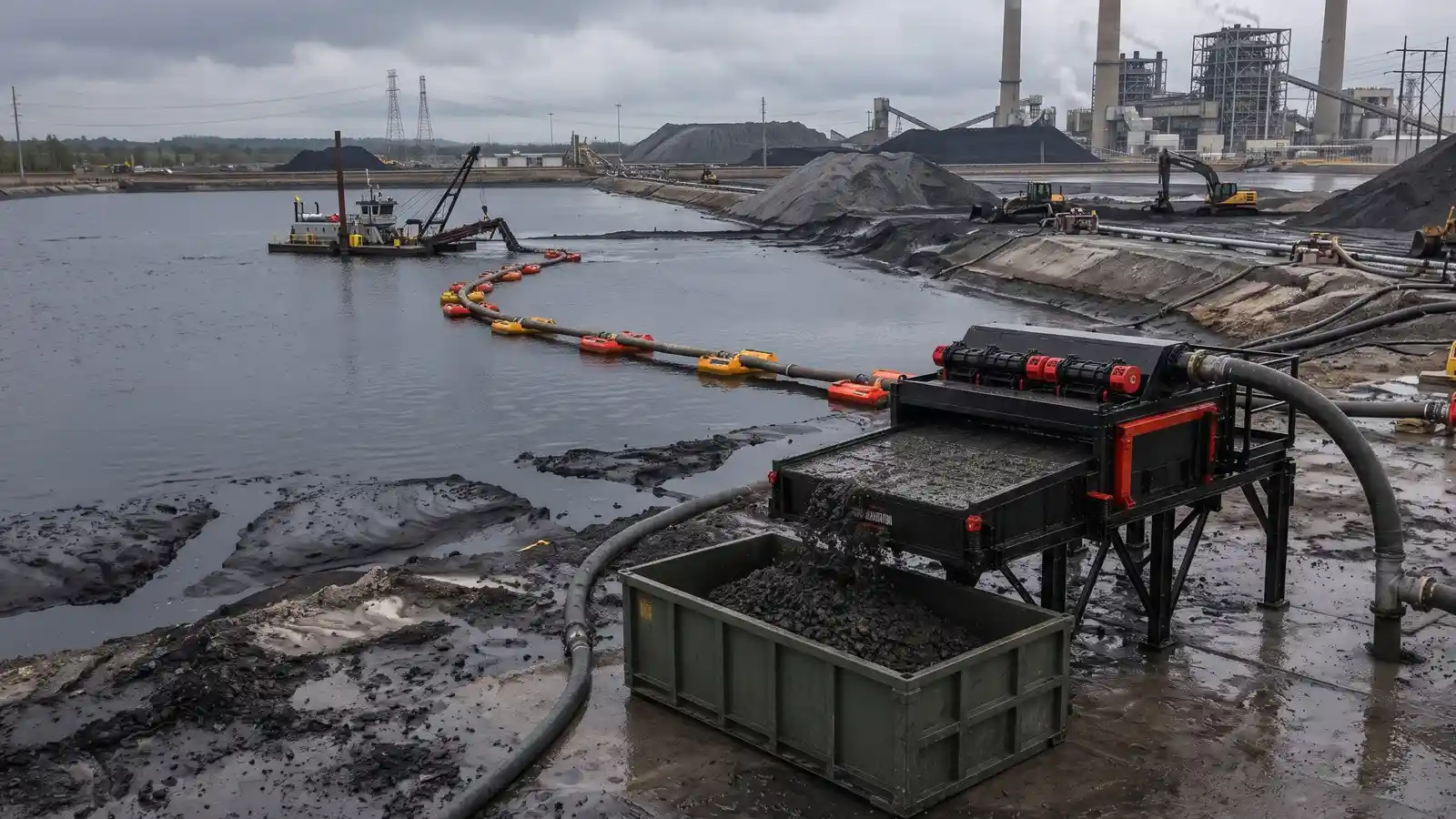
Coal ash and coal-slurry pond projects require a site-specific treatment train because the feed can be fine, abrasive, chemically variable, and regulated under overlapping solid-waste and water programs. Pump-fed shaker screening can remove debris and a selected size fraction, but it should not be represented as a standalone solution for all fly ash fines or discharge requirements.
| KEY TAKEAWAY |
| First confirm the unit status, approved closure or corrective-action plan, material characterization, water pathway, solids destination, and current regulatory obligations. Then size screening, conditioning, downstream dewatering, water treatment, monitoring, and material handling as one integrated process. |
Practical Engineering Perspective
Our practical role is to configure the pump-to-screen portion around the feed and production goal. For CCR work, the utility and its environmental and engineering teams must define the regulatory and acceptance envelope; the equipment package then has a measurable duty inside that plan.
This article reflects Slurry Separation’s published engineering and configuration approach. It does not claim that every material has been field-tested. For a high-consequence or unfamiliar duty, use representative testing and written acceptance criteria before procurement.
Material Characteristics Specific to Fly Ash and Coal Slurry
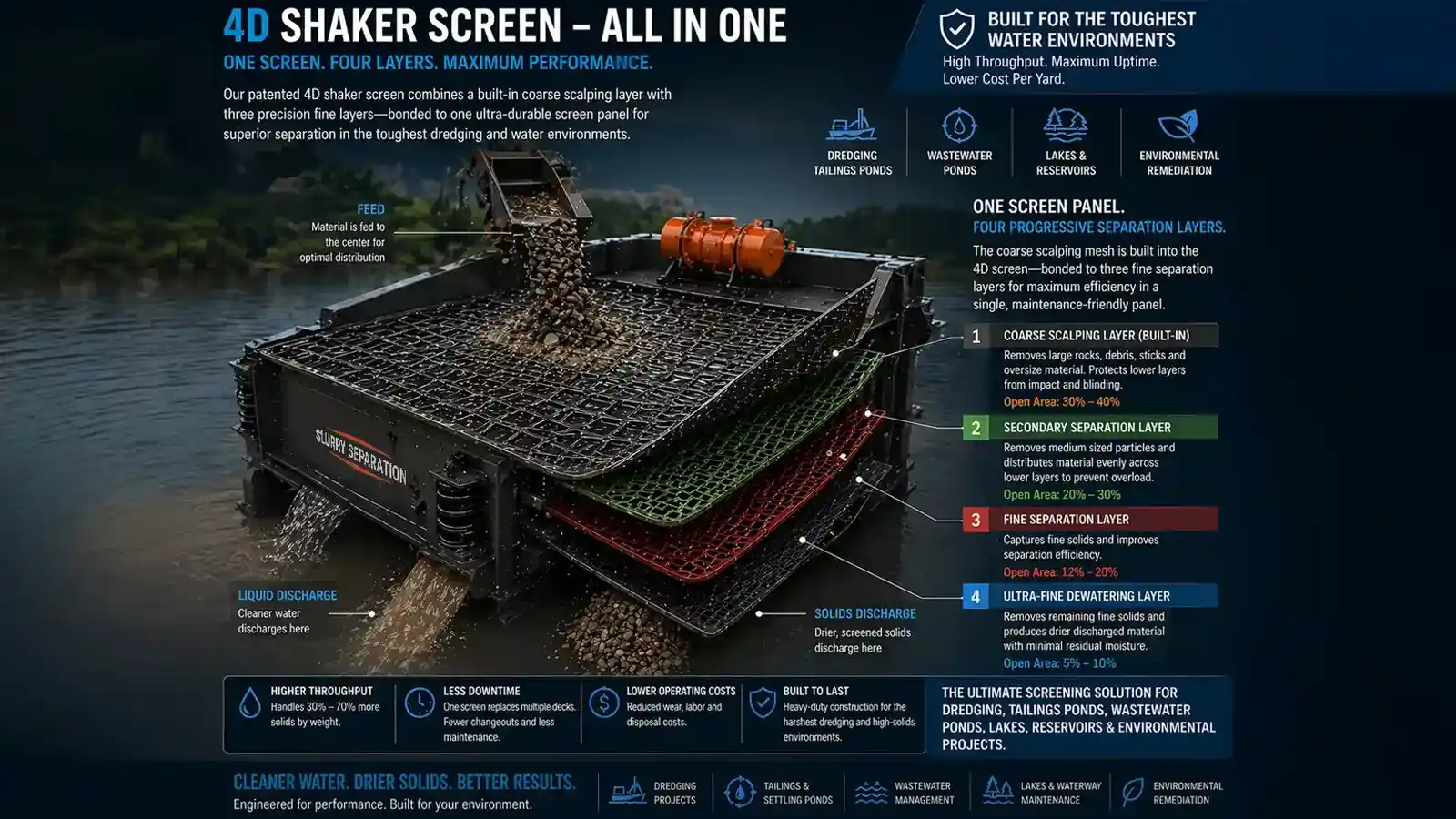
Fly ash can contain a substantial fine fraction, but material varies by source, combustion process, pond history, bottom-ash content, weathering, and dredging location. Screen performance depends on the actual PSD, shape, agglomeration, debris, carbon, chemistry, and feed. Use a shaker for the fraction it can reliably retain and drain; route remaining fines and water to the approved downstream process.
Regulatory Context Driving CCR Pond Dewatering Projects
EPA’s CCR program has changed since the original 2015 rule, including the 2024 legacy surface-impoundment rule, later corrections, and 2026 proposed amendments. Proposed changes are not final requirements. Confirm the current federal rule, state program, permits, orders, unit status, deadlines, closure plan, and Clean Water Act interface with the utility’s legal and environmental teams before publication and procurement.
Closure-in-Place vs. Closure-by-Removal Implications for Separation
Closure-in-place typically involves dewatering the pond to a stable condition suitable for capping, without necessarily removing all material offsite—a different separation and dewatering endpoint than closure-by-removal, which requires processing the full material volume to a condition suitable for hauling and disposal or beneficial reuse elsewhere. Confirming which closure approach applies to a specific project early in planning directly affects separation system sizing and the target dewatered solids condition the project actually needs to achieve.
Beneficial Reuse Considerations
Beneficial use is not created by dewatering alone. A defined end user must accept the material’s chemical and physical quality, consistency, moisture, contamination profile, logistics, and regulatory status. Treat reuse revenue as contingent until representative testing, contracts, permits, and quality-control requirements are established.
Coordination With Groundwater Monitoring and Environmental Compliance
CCR pond dewatering projects typically operate alongside active groundwater monitoring programs required under the applicable regulatory framework, and separation system operation (including any water discharge or infiltration from separation processes) should be planned in coordination with this monitoring program rather than as an independent technical activity disconnected from the site’s broader environmental compliance obligations.
Scale and Timeline Planning for Utility-Scale Ponds
Energy plant coal slurry and fly ash ponds are frequently large, sometimes covering many acres, with correspondingly large total dewatering volumes and multi-year project timelines for full closure or dewatering—separation capacity planning at this scale should account for the full project timeline and volume rather than treating separation as a smaller, shorter-duration task, and often favors either substantial fixed installation or a large mobile fleet operated over an extended deployment period, discussed further in our mobile versus fixed systems guide.
Working With Utility Environmental and Engineering Teams
Energy plant CCR pond projects typically involve close coordination with the utility’s own environmental compliance and engineering staff, who carry direct responsibility for the facility’s regulatory standing under the applicable CCR rule requirements. Separation technology and project planning decisions should be developed collaboratively with this internal team rather than as an independent contractor recommendation presented after the fact, given how directly separation performance ties into the facility’s regulatory compliance obligations and reporting requirements.
Engineering Pros-and-Cons Framework
Use this framework during design review and bid leveling. It makes the trade-offs explicit and prevents a low equipment price from hiding downstream cost or risk.
| Project path | Separation objective | Key procurement consequence |
|---|---|---|
| Closure in place / dewatering | Remove/manage water to support the approved closure design | Endpoint is geotechnical and regulatory, not merely “dry solids” |
| Closure by removal | Process material for excavation, hauling, disposal or approved reuse | Throughput, transport moisture and receiving-facility criteria dominate |
| Beneficial-use campaign | Produce material accepted by a defined user/process | Quality, consistency, contamination and contracts must be proven |
| Water treatment train | Meet reuse, NPDES or other approved water criteria | Primary screening is only one barrier |
What to Send for a System Recommendation
- Unit status, owner-approved closure/corrective-action plan, schedule, regulatory contacts, engineering basis, permits, and required documentation
- Ash/slurry source, sampling plan, PSD, density, solids, carbon, debris, abrasiveness, pH, temperature, chemistry, leachability/contaminants, and variability
- Pump and line data, flow/solids load, selected screen duty, downstream dewatering/treatment, storage, bypass, redundancy, and acceptance test
- Water inventory and pathway, groundwater/surface-water interfaces, discharge/reuse criteria, stormwater, monitoring points, methods, action levels, and residuals
- Solids destination, transport moisture, landfill or beneficial-use acceptance, conveyors/stockpiles, dust controls, containment, cleaning, access, utilities, staffing, schedule, and quote date
Frequently Asked Questions
Can a shaker capture all fly ash?
No. Fine and colloidal material can pass a screen. Establish the screen duty from representative material and provide downstream treatment for the remaining fraction.
Does closure method change equipment selection?
Yes. Closure design, water endpoint, solids destination, schedule, geotechnical criteria, and transport requirements change the separation duty.
Can dewatered ash automatically be sold for beneficial use?
No. A receiving market, quality specification, regulatory pathway, representative testing, and commercial agreement are required.
Which CCR regulation should the article cite?
Link to EPA’s current CCR program page and have counsel/environmental staff verify the project-specific rule status at publication.
Is groundwater monitoring part of the shaker package?
No. It is part of the site compliance program. The separation layout and water pathways must be coordinated with that program.
Related Slurry Separation Resources
- coal ash and abrasive residual applications
- 4D shaker screens
- direct pump integration
- system configurations
Request a Project-Specific System Recommendation
Send the team your pump and flow data, solids concentration and particle distribution, material characteristics, screen or separation target, water and solids endpoints, site layout, utilities, operating schedule, and production goal. Slurry Separation can review the application and recommend a pump-matched, skid-mounted, barge-mounted, or modular configuration based on current product options.
Request a System Recommendation or call (619) 383-6312.