
- Practical Engineering Perspective
- Understanding What Turbidity and TSS Limits Actually Measure
- Why "Getting the Water Clear Enough" Isn't a Reliable Design Target
- Designing Separation Capacity With Real Margin
- Monitoring Frequency and Location
- Responding to a Developing Exceedance Risk
- Seasonal and Variable Condition Planning
- Documentation and Regulatory Reporting
- Engineering Pros-and-Cons Framework
- What to Send for a System Recommendation
- Frequently Asked Questions
- Related Slurry Separation Resources
- Request a Project-Specific System Recommendation
A measurement-led operating plan that distinguishes primary screening from final compliance.
Return-water control starts with the exact permit or reuse criteria, not a visual clarity target. A shaker can remove the fraction retained by its screens and reduce downstream solids load, but the complete train must be designed, monitored, and operated to meet every applicable limit at the required location and frequency.
| KEY TAKEAWAY |
| Create a source-to-discharge control plan: characterize feed, assign each treatment barrier a duty, identify normal and peak loads, select approved analytical methods and instruments, set warning/action/stop levels below the compliance limit, and define who adjusts dredging, screens, chemicals, storage, polishing, or discharge. |
Practical Engineering Perspective
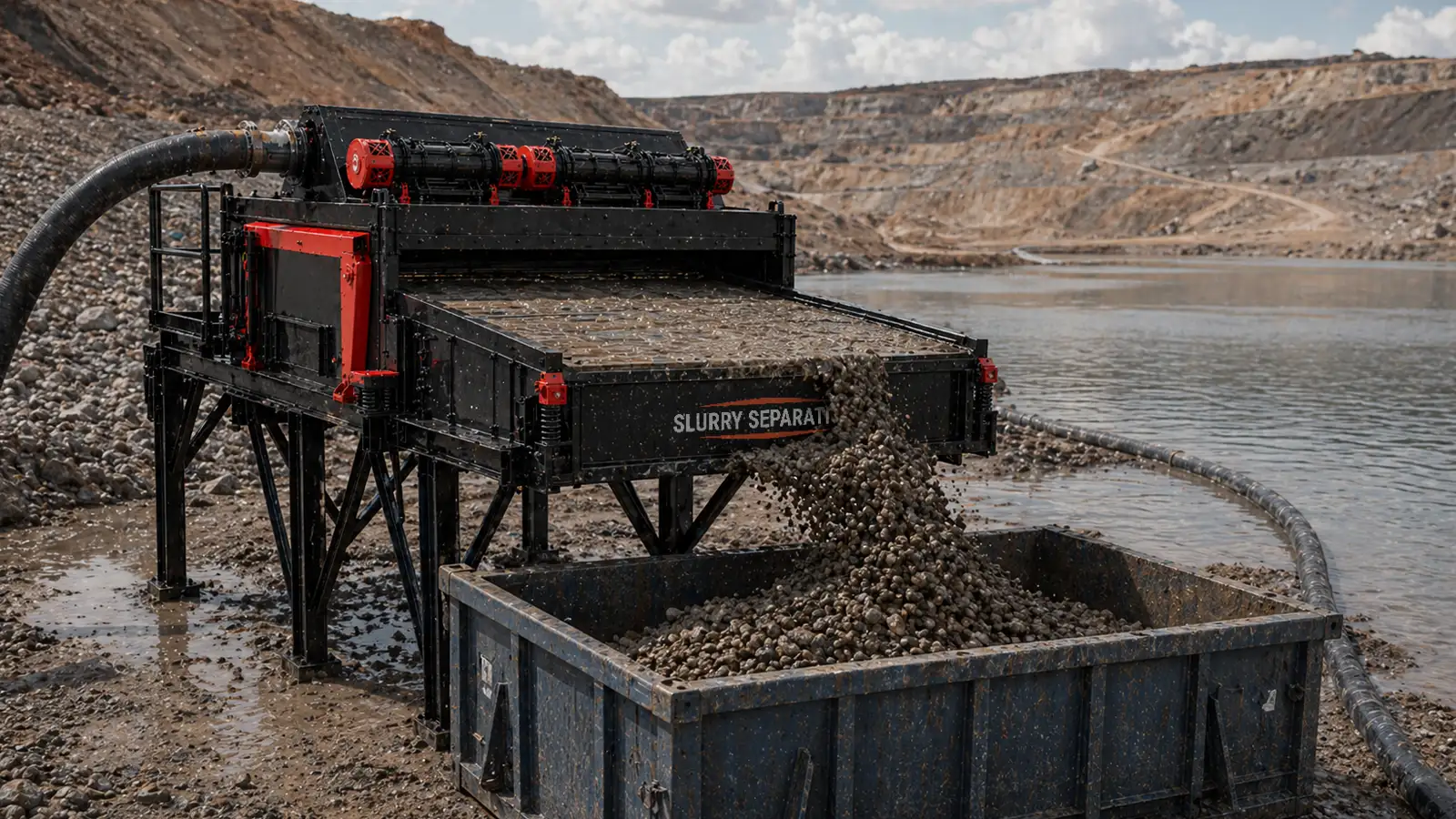
When we review direct pump-fed separation, we distinguish screen performance from final water acceptance. That distinction prevents a common procurement error: purchasing enough screen GPM without providing the fine-solids treatment, storage, instrumentation, or operating authority needed at the compliance point.
This article reflects Slurry Separation’s published engineering and configuration approach. It does not claim that every material has been field-tested. For a high-consequence or unfamiliar duty, use representative testing and written acceptance criteria before procurement.
Understanding What Turbidity and TSS Limits Actually Measure
Turbidity is an optical response reported in NTU; TSS is a laboratory mass concentration, usually mg/L. Their relationship varies with particle size, shape, color, refractive properties, and organics. A site-specific correlation can support operations, but one metric cannot be converted reliably into the other with a universal formula. Use the metric, method, averaging period, and location specified by the permit or process owner.
Why “Getting the Water Clear Enough” Isn’t a Reliable Design Target
Visual clarity assessment is not a reliable substitute for actual turbidity or TSS measurement—water that looks reasonably clear to visual inspection can still exceed a specific numeric permit limit, particularly for stringent limits protecting sensitive receiving waters. Separation system design and operation should be planned and verified against the actual numeric permit requirement using calibrated monitoring instruments, not visual assessment alone, which is a common and preventable source of permit compliance problems on dredging projects.
Designing Separation Capacity With Real Margin
Define margin from feed variability, method uncertainty, treatment response time, monitoring lag, consequence of exceedance, storage, and the ability to reduce production. Separate hydraulic capacity from solids/treatment capacity. A nameplate-sized screen train with no hold-and-test or downstream margin can still fail when fines increase or chemistry changes.
Monitoring Frequency and Location
Monitor where and how the permit or reuse specification requires. Operational instruments may also be placed upstream, between stages, or at a treatment outlet to provide earlier warning. Establish calibration, verification, cleaning, fouling checks, grab-sample confirmation, laboratory QA/QC, data review, and chain of custody. “Continuous” data are only useful when the sensor and location remain representative.
Responding to a Developing Exceedance Risk
Use tiered response levels. A warning trend can trigger inspection and confirmation; an action level can reduce dredge rate, adjust approved screen or chemical settings, route water to storage/recycle, or add capacity; a stop level can suspend discharge. Assign authority, communications, sampling, documentation, and restart criteria before the shift begins.
Seasonal and Variable Condition Planning
Some projects see genuine seasonal variability in receiving water sensitivity or applicable permit limits (stricter limits during certain seasons for sensitive aquatic life stages, for example) or in the material being dredged (different sediment characteristics at different points across a project’s duration). Separation system design and operating plans should account for this variability explicitly, rather than assuming a single set of conditions and requirements holds constant across the entire project duration.
Documentation and Regulatory Reporting
Most dredging permits require documented water quality monitoring records, and maintaining accurate, contemporaneous documentation—not reconstructed after the fact—both satisfies the direct regulatory reporting requirement and creates a useful record for identifying performance trends or diagnosing a developing problem before it progresses to a serious compliance issue. Building documentation practice into standard operating procedure from project start, rather than treating it as a separate administrative task, supports both compliance and practical operational awareness.
Engineering Pros-and-Cons Framework
Use this framework during design review and bid leveling. It makes the trade-offs explicit and prevents a low equipment price from hiding downstream cost or risk.
| Control layer | Leading indicator | Preplanned response |
|---|---|---|
| Dredge/pump feed | Flow, solids load, material change | Slow production, change cut/path or equalize feed |
| Shaker stage | Deck loading, overflow, blinding, carryover | Adjust approved feed, screen, angle, force or maintenance |
| Downstream treatment | Dose, detention, differential pressure, filtrate trend | Adjust process or add/rotate capacity |
| Compliance/reuse point | Permit/process metric and trend | Hold, recycle, divert or stop discharge under plan |
What to Send for a System Recommendation
- Current permit/order/process specification, numeric and narrative limits, averaging period, background allowance, compliance point, monitoring frequency, approved methods, reporting, and notification duties
- Baseline receiving-water/process data; feed flow, solids, PSD, chemistry, temperature and variability; rainfall, wind, seasonal, and upset cases
- Pump/line/separator configuration, screen target, downstream treatment barriers, storage/hold-and-test capacity, recycle/bypass, redundancy, and production control range
- Online/grab-sample instruments, calibration/verification, laboratory chain of custody, sampling access, data logging, QA/QC, warning/action/stop levels, authority, and communication
- Solids/residuals route, treatment chemicals, discharge structure, erosion controls, spill containment, staffing, operating hours, contingency equipment, schedule, and quote date
Frequently Asked Questions
Are turbidity and TSS interchangeable?
No. They are related but different measurements, and the relationship changes with the material.
Can clear-looking water exceed a limit?
Yes. Visual checks are useful for gross changes but cannot replace the required measurement.
Does a 4D screen guarantee discharge compliance?
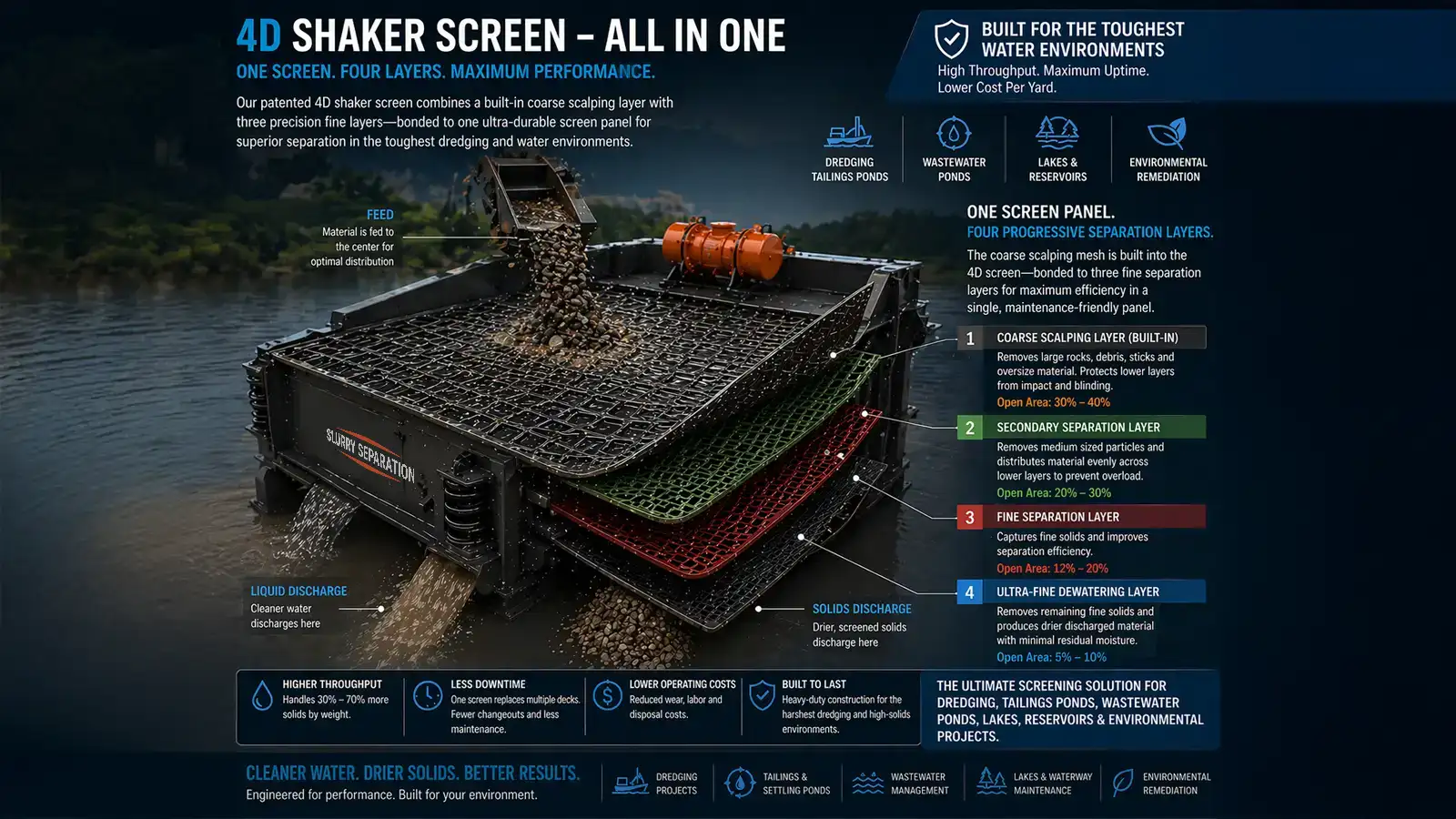
No. It improves staged screening and dewatering; final water quality depends on feed, screen, downstream treatment, monitoring, and the applicable criteria.
Where should monitoring occur?
At the permit or process-required point, with additional operational points where they provide useful early warning.
What is the most valuable contingency?
The ability to hold, recycle, divert, or stop discharge while the team diagnoses and corrects the process—supported by clear authority and restart criteria.
Related Slurry Separation Resources
- direct pump-to-shaker integration
- 4D Separation System
- system configurations
- dewatering applications
Request a Project-Specific System Recommendation
Send the team your pump and flow data, solids concentration and particle distribution, material characteristics, screen or separation target, water and solids endpoints, site layout, utilities, operating schedule, and production goal. Slurry Separation can review the application and recommend a pump-matched, skid-mounted, barge-mounted, or modular configuration based on current product options.
Request a System Recommendation or call (619) 383-6312.